
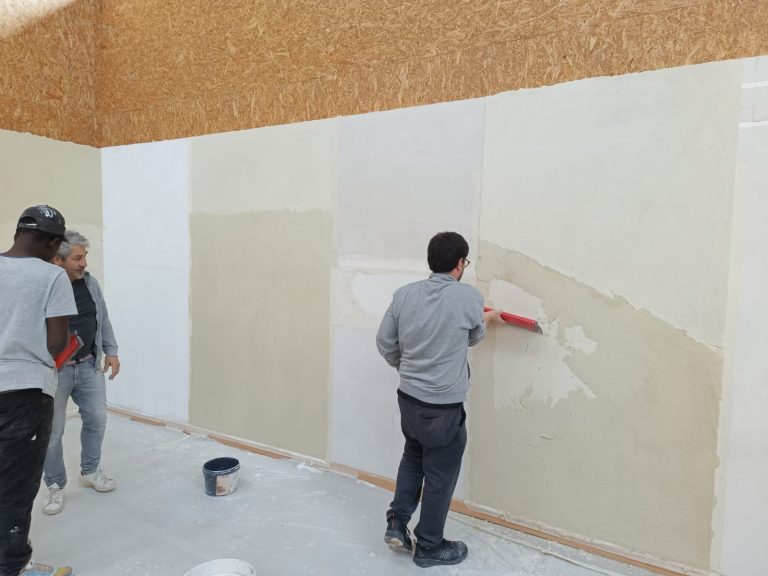
The role of the applicator is undergoing profound changes
For a long time, in the construction and decorative finishes industry, product training sessions were often viewed as mere technical demonstrations:
- brief overview of the material,
- explanation of the application steps,
- delivery of documentation,
- then back to the job site.
But professionals' expectations have changed.
Today, applicators are no longer just looking to learn “how to apply a product.”
They want to understand:
- how a material reacts,
- how to read a medium,
- how to anticipate construction challenges,
- how to achieve an even finish,
- and, above all, how to develop true technical mastery.
This trend is even more evident with bio-based materials and eco-friendly wall coverings, where the final result depends as much on the craftsmanship as on the product itself.
The Absolin Academy was designed with this in mind.
Training an applicator is no longer just about teaching a protocol
In many traditional training programs, the main goal remains:
- learn a process,
- repeat the steps,
- apply a standardized method.
The problem is that real-world construction sites are never standardized.
An applicator must constantly adapt:
- to the supports,
- depending on weather conditions,
- to drying constraints,
- to the absorption of the walls,
- aesthetic expectations,
- in line with the construction schedule.
Two parts that appear identical on paper may behave completely differently when put into use.
This is precisely why some professionals quickly master a subject while others struggle:
- replays,
- irregularities,
- excessive consumption of a product,
- finishing issues.
The difference often lies less in the product itself than in the ability to understand the project.
Bio-based materials require a more careful approach to the substrate
Bio-based coatings do not behave like highly synthetic or highly film-forming systems.
Mineral and plant matter interact more with their environment.
This means:
- a closer look at the wall,
- a better understanding of humidity,
- precise control of the substrate tension,
- control over working hours,
- the ability to adapt continuously.
In practice, this fundamentally changes the profession.
The applicator is no longer merely an executor.
He becomes a true interpreter of the medium and the material.
Why the process remains central to the final result
In finishing trades, technique has a direct impact on:
- aesthetics,
- the texture,
- the depth of the material,
- regularity,
- the light,
- and even the overall perception of a space.
The pressure applied,
the working angle,
the application rate,
handling of touch-ups,
reading the material
significantly alter the final result.
This is a reality that is often overlooked in overly “industrialized” approaches to training.
However, with eco-friendly wall coverings, these details become immediately apparent.
Two applicators using exactly the same product can achieve very different results.
The Absolin Academy: An Approach Designed for Real-World Application
The Absolin Academy was founded on a simple idea:
to train professionals who truly understand the subject matter and the materials.
The goal isn’t just to show:
“what to do.”
The main goal is to explain:
“why do it.”
This difference profoundly changes the learning process.
The training program includes, in particular:
- analysis of the materials,
- the preparation of funds,
- an understanding of hygrometric behavior,
- absorption management,
- installation techniques,
- expertise in finishing,
- the actual constraints of the construction site.
The approach remains deliberately practical and field-oriented.
Understand the substrate before applying
One of the most common mistakes in the flooring industry is rushing into the application process.
However, many problems arise long before the bucket is opened:
- bracket too tight,
- damp wall,
- lack of cohesion,
- irregular absorption,
- old, incompatible layers.
At the Absolin Academy, a significant part of the work involves learning to observe.
Because an experienced applicator doesn't just look at the product.
First, they analyze:
- the wall,
- his behavior,
- its tensions,
- its possible reactions.
This analytical skill is essential in today’s renovation projects, where substrates are often diverse and complex.
Technology alone is no longer enough
In many sectors of the construction industry, technical skills remain essential.
But they are no longer enough on their own.
Today, professionals must manage:
- environmental expectations,
- aesthetic requirements,
- time constraints,
- requests for customization,
- indoor air quality,
- the new regulations,
- sustainability expectations.
It takes more than just technical proficiency.
This requires:
- of the adaptation,
- from the site survey,
- technical judgment,
and a comprehensive understanding of the material.
Why professionals are looking for more immersive training programs
Experienced applicators know that a quick demonstration isn't enough to master a material.
What they are now looking for are training programs that can teach:
- reflexes,
- a work process,
- a sensitivity to materials,
- an understanding of errors,
- a realistic view of the construction site.
This trend explains the rise of immersive, hands-on training programs.
Professionals want to see:
- defects,
- the corrections,
- the constraints,
- unexpected events,
- real-world situations.
Because that is exactly what they will encounter next when working with their clients.
The sector's move upmarket is also changing expectations
The market is shifting toward projects that emphasize quality:
- high-end renovation,
- hospitality industry,
- premium spaces,
- interior design,
- low-carbon buildings,
- wellness-focused venues.
In these environments, surface finishes become highly noticeable.
Customers expect:
- consistency,
- of the master's degree,
- consistency,
- truly perceived quality.
However, this quality does not depend solely on the material.
It also depends a great deal on:
- of the applicator,
- based on his experience,
and their understanding of the product.
Training programs are becoming a key differentiator
In a market where many companies offer similar services, technical expertise becomes a key differentiator.
A well-trained applicator can:
- limit rework,
- better manage the unexpected,
- optimize energy consumption,
- improve consistency,
- improve customer satisfaction.
In the long term, this has a direct impact on:
- reputation,
- profitability,
- customer loyalty,
- and the overall quality of the projects.
Training should therefore no longer be viewed as a burden or an administrative formality.
They become a real business investment.
A focus on transmission rather than mere demonstration
The Absolin Academy is rooted in a tradition of craftsmanship and technical expertise:
to impart a genuine understanding of the material and how to work with it.
This approach is based on several key elements:
- observation,
- in practice,
- error analysis,
- the repetition of the action,
- adaptation to real-world environments.
The goal is not to create a one-size-fits-all approach that is identical across all projects.
The goal is to train professionals who can adapt effectively to the situations they encounter.
The Return of Traditional Building Skills
After several years dominated by speed and standardization, many professionals are now turning back to:
- living matter,
- more sustainable approaches,
- more demanding techniques,
- implementation expertise.
This development is not merely an aesthetic trend.
She also translates:
- high-quality research,
- a commitment to sustainability,
- greater consideration of interior comfort,
- and a growing demand for materials that are more in line with current environmental concerns.
In this context, training becomes essential.
Because even a high-performance material loses much of its potential if it is applied incorrectly.
The profession of applicator is currently undergoing a profound transformation.
With more technical materials, more complex media, and higher expectations, professionals are now looking for more than just a simple product presentation.
They want:
- understand,
- master,
- experiment,
- and develop genuine expertise in implementation.
This is the philosophy that guides the Absolin Academy:
—combining materials, techniques, an understanding of the substrate, and real-world construction site conditions into a practical and professional approach.
Because in the finishing trades, the final quality never depends solely on the material.
It depends mainly on how it is understood and applied.