
Schools, daycare centers, nursing homes, offices, or public buildings: Learn how to incorporate eco-friendly wall coverings into a public-access building project while keeping project timelines, costs, and site organization under control.
ERP: Why Material Selection Has Become a Strategic Decision
Public-access facilities (ERP) are now facing an increasing number of requirements.
Local governments, building managers, project owners, and project managers must address several challenges simultaneously:
- indoor air quality;
- sustainability of structures;
- occupant comfort;
- environmental impact;
- budgetary control;
- meeting deadlines.
In this context, bio-based materials and eco-friendly wall coverings are attracting growing interest.
However, some misconceptions still persist.
Many stakeholders fear that implementing an innovative solution will complicate the project, increase risks, or extend the timeline.
The reality is often different when the project is properly prepared.
A common concern: avoiding any additional complexity
In an ERP project, the priority remains ensuring the project's continuity.
Project management teams are primarily looking for solutions that can be easily integrated into the planned structure.
The main obstacle, therefore, is not necessarily the cost or performance of the material.
It is often the fear of introducing additional uncertainty.
These questions come up regularly:
- Is the product easy to apply?
- Are there any companies capable of implementing it?
- Will the deadlines be met?
- Will the construction project require any special adjustments?
- Will teams have to change their habits?
When these questions are clearly answered, integration becomes much easier.
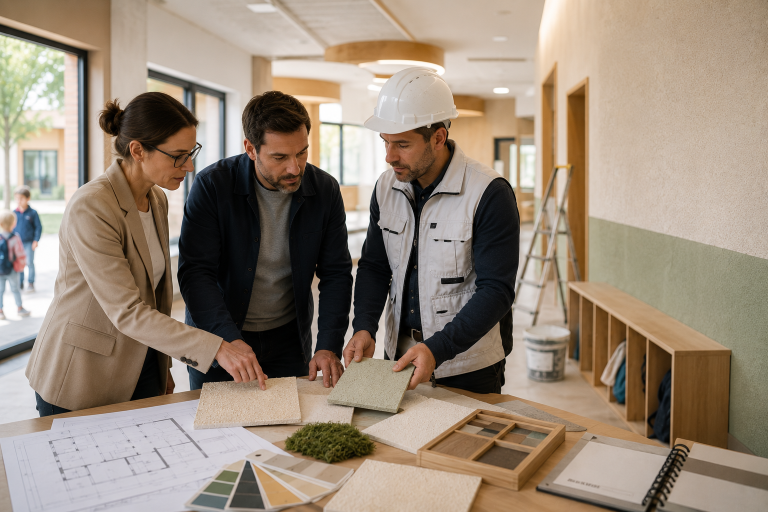
Plan Ahead Starting in the Design Phase
One of the keys to success is to incorporate the choice of flooring early enough in the project.
The earlier the decision is made, the more the teams can plan ahead:
- the characteristics of the medium;
- the required quantities;
- the phasing of the work;
- the implementing rules;
- any technical constraints.
This proactive approach helps avoid most of the difficulties typically encountered during the construction phase.
It also facilitates communication between architects, project managers, contractors, and manufacturers.
Choose a solution tailored to the building's specific context
Not all public buildings are subject to the same restrictions.
A school, a nursing home, a media center, or an administrative building will not necessarily have the same needs.
The choice of flooring must take several criteria into account:
- the number of visitors to the premises;
- maintenance requirements;
- operational constraints;
- environmental goals;
- aesthetic expectations.
The goal is not to select the most innovative product, but the one that best meets the project's actual needs.
This pragmatic approach significantly reduces risks.
Train applicators to ensure workplace safety
The quality of implementation plays a central role in the success of an ERP project.
A high-performance coating that is applied incorrectly can quickly become a source of problems.
That is why many stakeholders now give preference to companies with teams trained in bio-based solutions.
This skills development enables:
- to improve the quality of execution;
- to minimize errors;
- to reduce rework;
- to optimize turnaround times;
- to ensure the final result.
Training thus becomes a tool for managing construction site risks.
A Solution to Indoor Air Quality Challenges
Public buildings welcome large numbers of people every day.
The issue of indoor air quality is therefore of particular importance.
Occupants sometimes spend several hours a day in these buildings:
- students;
- teachers;
- administrative staff;
- residents;
- visitors;
- patients.
The choice of materials plays a direct role in creating healthier environments.
This concern has become an important factor in decision-making for many construction or renovation projects.
Reduce future interventions
A construction project doesn't end when the work is accepted.
Building managers are also concerned about future operating costs.
A durable coating helps reduce:
- repairs;
- premature renovations;
- maintenance costs;
- service interruptions.
This total-cost approach is particularly relevant in public-sector real estate, where buildings must remain functional for many years.
Highlight the project's environmental commitment
Local governments and project owners are paying increasing attention to the environmental image of their projects.
Choosing bio-based materials helps demonstrate a concrete commitment to the ecological transition.
This approach can help:
- promoting the project;
- corporate communications;
- measures to address environmental objectives;
- improving the quality of life for users.
Mineral and plant-based materials are fully in line with this trend.
The Essential Role of Technical Support
Installing eco-friendly wall coverings is all the easier when the teams receive the right support.
General contractors generally value partners who can provide:
- technical recommendations;
- pre-construction assistance;
- implementation guidelines;
- training courses;
- clear documentation.
This support reduces uncertainty and facilitates decision-making.
It also helps ensure that the construction project runs smoothly.
ERP: An Opportunity for Bio-Based Solutions
Schools, daycare centers, healthcare facilities, government offices, and cultural venues now represent a particularly dynamic market for eco-friendly wall coverings.
These projects are seeking solutions that can combine:
- performance;
- sustainability;
- aesthetics;
- comfort;
- environmental responsibility.
Bio-based materials meet these expectations when they are incorporated into a coherent, comprehensive approach.
Contrary to popular belief, incorporating eco-friendly wall coverings into a public building project does not make the construction process more complicated.
When the choice of material is planned in advance, the teams are trained, and technical support is appropriate, these solutions fit naturally into the project’s organization.
Beyond their environmental benefits, they provide concrete solutions to the current challenges facing buildings open to the public: indoor air quality, sustainability, occupant comfort, and the promotion of responsible practices.
For both building owners and general contractors, this is no longer just an environmental choice. It is now a matter of the building’s overall performance.