
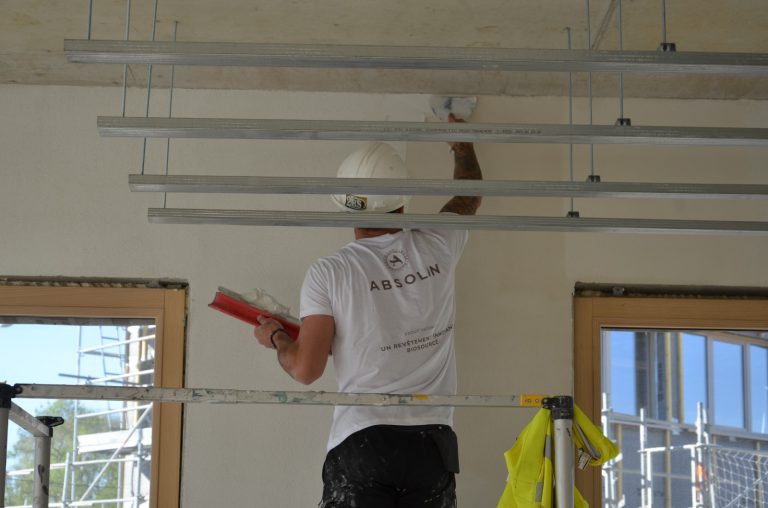
Demonstration projects are taking on new significance
In the construction industry, there is a growing focus on environmental issues:
- sustainable construction,
- bio-based materials,
- carbon reduction,
- indoor air quality,
- eco-friendly renovation,
- environmental performance.
But in the real world of business, professionals know that communication alone is no longer enough.
Project owners, architects, specifiers, and contractors are now looking for concrete evidence:
- completed projects,
- feedback from the field,
- actual constraints,
- material behavior,
- quality of implementation,
- overall consistency of the project.
This is precisely why demonstration projects are becoming increasingly important.
Today, a project that is transparent, well-documented, and technically sound has become a key driver of credibility for construction companies.
The FERROCAMPUS construction site, located in Saintes, is fully in line with this initiative.
The building is entering a new phase of transformation
For several years now, the sector has been evolving rapidly as a result of:
- environmental requirements,
- of RE2020,
- the expectations of local communities,
- new customer requests,
- and carbon reduction targets.
This change no longer applies only to:
- insulation,
- energy consumption,
- or technical equipment.
It now applies to:
- materials,
- building systems,
- the finishes,
- and the choice of finishes.
Low-carbon projects are no longer considered niche initiatives.
They are gradually becoming key benchmarks for the entire sector.
Why Pilot Projects Have Such a Big Impact on the Market
In the construction industry, professionals place greater trust in:
- in a real-world project,
- rather than a sales pitch.
A concrete project allows us to observe:
- overall consistency,
- technical choices,
- the challenges encountered,
- trade-offs,
- and how materials behave in real-world situations.
Today, construction companies use these standards to:
- reassure their customers,
- showcase their expertise,
- showcase their expertise,
- and strengthen their position in markets with strict environmental requirements.
A construction project then becomes much more than just a project:
it becomes a showcase of technical expertise.
FERROCAMPUS: A Construction Approach Focused on Low-Carbon Solutions
The FERROCAMPUS project is part of a comprehensive approach that includes:
- innovation,
- environmental performance,
- and a discussion of the materials used.
The project is based, in particular, on several key priorities:
- low-carbon approach,
- integration of sustainable solutions,
- work related to environmental performance,
- and overall constructive coherence.
In this type of project, every material choice becomes strategic.
Flooring is no longer chosen solely for its aesthetic appeal.
The following are also participating:
- to the overall quality of the building,
- in terms of interior comfort,
- environmental consistency,
- and the final perception of the project.
The Return of Mineral and Plant-Based Materials in Ambitious Projects
For several years now, architects and project managers have been gradually reintroducing:
- mineral substances,
- bio-based solutions,
- materials with a low environmental impact,
- and more sustainable building systems.
This development addresses several challenges:
- reduction of the carbon footprint,
- passenger comfort,
- structural durability,
- usability,
- and improved environmental sustainability of buildings.
In low-carbon projects, the materials used today must meet several criteria at the same time:
- construction feasibility,
- stability,
- aesthetics,
- sustainability,
and compatibility with environmental goals.
Credibility is now built on overall consistency
A credible low-carbon construction project does not rely solely on “green” materials.
The consistency of the project becomes essential.
Experts are now observing:
- constructive logic,
- material compatibility,
- the quality of implementation,
- expected durability,
- and the alignment between rhetoric and reality on the job site.
This is a point that is often overlooked in certain marketing approaches.
A project can demonstrate a strong commitment to environmental responsibility while maintaining:
- inconsistent materials,
- systems that are not very sustainable,
- or conflicting construction site practices.
Conversely, a well-coordinated project naturally enhances the credibility of the companies involved.
Implementation remains a decisive factor
In projects that use bio-based materials or eco-friendly wall coverings, the quality of the installation becomes particularly evident.
Mineral and plant-based materials require:
- a thorough review of the materials,
- a thorough understanding of the conditions for application,
- accurate tracking of work hours,
- and an understanding of how materials behave.
The final result therefore depends just as much on:
- of the product,
- only the applicator's movement.
That is why demonstration projects also serve an educational purpose.
They make it possible to show:
- the techniques used,
- the actual constraints,
- and the level of effort required to achieve lasting results.
Construction companies today are looking for concrete examples
As environmental requirements become more stringent, clients are paying closer attention:
- based on past achievements,
- to benchmark projects,
- and evidence of technical proficiency.
Companies that can demonstrate well-thought-out projects often succeed:
- in terms of credibility,
- in terms of visibility,
- and legitimacy.
This logic becomes particularly evident in:
- calls for bids,
- public projects,
- commercial buildings,
- the hotel industry,
- premium spaces,
- and architectural projects with a strong identity.
Project references then become a real competitive advantage.
Low-carbon projects are also transforming industries
The environmental transition isn't just about materials.
It also transforms:
- work methods,
- the expected skills,
- construction site coordination,
- and the technical requirements.
Professionals must now understand:
- interactions between materials,
- hygrometric issues,
- true sustainability,
- and the specific challenges associated with bio-based solutions.
This trend is driving the industry toward more:
- technical complexity,
- anticipation,
- and overall project management.
Demonstration projects are becoming tools that inspire confidence
In a market where many players claim to have a sustainable approach, professionals are looking for tangible evidence.
Demonstration projects make it possible to:
- to make commitments visible,
- to show the results,
- and to put an approach into practice.
They are also used to:
- reassure prospective customers,
- convince decision-makers,
- and build trust in the solutions we use.
In this vein, FERROCAMPUS goes beyond the simple framework of a construction site.
The project also becomes:
- a demonstration stand,
- an example of implementation,
- and a resource for companies committed to the building sector’s transition.
Why Actual Projects Matter More Than Promises
In the construction industry, trust remains deeply rooted in the local community.
Professionals know that between:
- a technical data sheet,
- a commercial communication,
- and the reality on the job site,
The differences can be significant.
That is why projects that are actually completed are so valuable.
They make it possible to assess:
- the quality of execution,
- consistency in decision-making,
- long-term durability,
- and companies' actual ability to handle more demanding solutions.
This reality becomes even more important in projects focused on low-carbon solutions and bio-based materials.
The buildings of tomorrow are also built by setting an example
The sector's environmental transformation will not rely solely on:
- regulations,
- labels,
- or technical requirements.
It will also move forward thanks to projects that can demonstrate that a different way of building is actually possible.
Demonstration projects therefore play a vital role:
- they highlight trends in the industry,
- they share best practices,
- and they are accelerating the adoption of new, constructive approaches.
In this context, companies capable of participating in well-coordinated and challenging projects are gradually gaining a competitive edge.
With environmental standards becoming increasingly stringent, construction companies today must go beyond mere rhetoric.
Actual construction projects serve as proof of credibility, technical expertise, and consistent design.
The FERROCAMPUS project illustrates this trend:
is a construction site where material choices, environmental goals, and the quality of workmanship all contribute to an overarching approach focused on low-carbon construction.
In a rapidly changing market, concrete examples become powerful drivers of trust for:
- architects,
- project owners,
- companies,
- and future partners.
Because, at the end of the day, in the construction industry, it’s often the visible results that speak the loudest.