
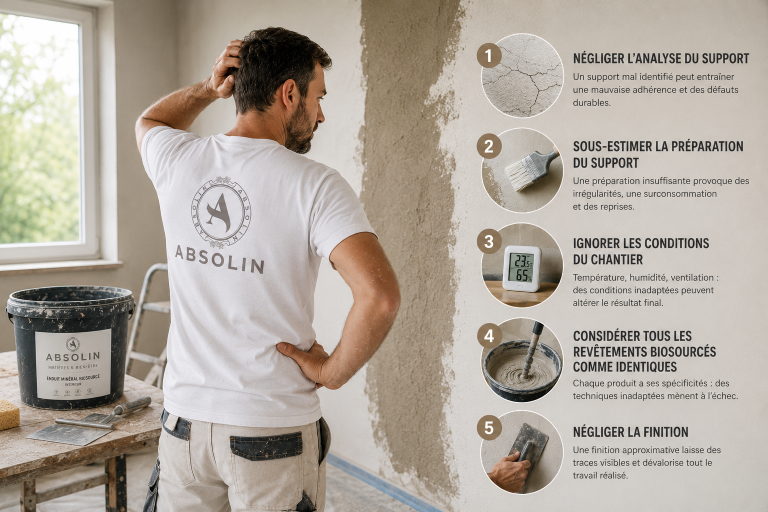
Surface preparation, application conditions, tool selection: Discover the 5 most common mistakes made when installing a bio-based flooring and the best practices to ensure a long-lasting result.
A good product can never make up for poor implementation
The market for bio-based materials is experiencing significant growth. Architects, general contractors, local governments, and businesses are seeking solutions that can address today’s environmental challenges while ensuring a high level of performance.
However, one fact remains: even the best eco-friendly wall covering cannot make up for poor installation.
In the field, the problems encountered are rarely related to the product itself. They often stem from mistakes made before or during application.
These errors can lead to cosmetic defects, wasted time, additional costs, or dissatisfaction on the part of the end customer.
Here are the five most common mistakes observed on construction sites.
Mistake #1: Neglecting to analyze the medium
This is probably the most common mistake.
Whether due to a lack of time or out of habit, some technicians start the application without carefully assessing the condition of the surface.
However, not all walls react the same way.
Before performing any work, several items must be checked:
- the cohesion of the substrate;
- the presence of cracks;
- the level of porosity;
- any moisture;
- the existing layers;
- overall flatness.
An incorrectly identified medium can result in:
- poor traction;
- differences in appearance;
- visible repairs;
- a reduction in the coating's durability.
Experienced professionals often believe that the success of a construction project is determined even before the first bucket is opened.
Mistake #2: Underestimating the importance of surface preparation
The first step is to analyze the material.
Preparation is the second step.
However, it is often this part that gets cut back when deadlines are tight.
This approach can be very expensive.
Inadequate preparation can lead to:
- finishing defects;
- visual irregularities;
- excessive use of materials;
- difficulties in implementation.
The mounting surface must be clean, stable, and suitable for the chosen system.
In many cases, the time spent on preparation saves several hours of grading later on.
The most successful companies know that the final quality depends directly on the level of attention to detail at this stage.
Mistake #3: Ignoring the site conditions
Bio-based materials, like all finishing materials, react to their environment.
Temperature, humidity, and ventilation directly influence their behavior.
However, these factors are sometimes overlooked.
A construction site that is too damp or not sufficiently ventilated can lead to:
- longer drying times;
- differences in appearance;
- scheduling delays;
- unexpected restarts.
Conversely, certain conditions—such as those that are too dry or too hot—can speed up the drying process and make application more difficult.
Accurately anticipating site conditions is therefore an essential factor in the project's success.
Mistake No. 4: Assuming that all bio-based coatings are the same
The term “bio-based” now encompasses a wide variety of solutions.
This abundance can sometimes lead to confusion.
Each system has its own characteristics:
- composition;
- behavior;
- application method;
- drying time;
- finishing.
A common mistake is to apply habits learned with one product to a completely different product.
This approach may yield disappointing results.
Professionals who achieve the best results always take the time to understand the specifics of the system they are using.
Skill development and training play a crucial role here.
Mistake #5: Neglecting the finishing touches
The finish is often the last impression the customer takes away.
However, as the project nears completion, fatigue and time pressure can lead to less rigorous workmanship.
This phase, however, deserves special attention.
A sloppy finish can significantly reduce the perceived value of the project.
The most sensitive issues generally involve:
- fittings;
- angles;
- replays;
- decorative details;
- the uniformity of the whole.
High-quality, eco-friendly wall covering deserves a finish that matches its performance.
Why These Mistakes Cost More Than We Realize
The consequences are not merely cosmetic.
Each error often results in:
- overtime;
- recall costs;
- a work stoppage;
- a loss of customer trust;
- a decline in profitability.
In an environment where margins are sometimes tight, these impacts can become significant.
That is why the most successful companies seek to mitigate risks from the outset rather than correct problems after the fact.
The Role of Training in the Success of Construction Projects
As materials and market demands evolve, training is becoming a key tool for improving performance.
It enables teams to:
- gain a better understanding of the materials;
- master application techniques;
- anticipate difficulties;
- improve the quality of the finishes;
- improve efficiency.
For businesses, this skills development represents a profitable long-term investment.
It helps ensure the success of projects and boost customer satisfaction.
A Growing Demand from Project Owners
Today, clients expect more than just the completion of a project.
They are looking for:
- companies capable of providing advice;
- qualified teams;
- sustainable solutions;
- consistently high-quality results.
This trend naturally benefits professionals who invest in their expertise and in mastering innovative materials.
Bio-based coatings are fully in line with this trend.
The difficulties encountered on construction sites are rarely due to chance.
In most cases, these issues stem from a few recurring mistakes: improper analysis of the substrate, insufficient preparation, poorly controlled job site conditions, lack of product knowledge, or a neglected finish.
The good news is that these errors can largely be avoided through a rigorous methodology, experience, and training.
In a market where the quality of workmanship is becoming a key differentiator, mastering these best practices is a major advantage for companies seeking to develop their expertise in bio-based coatings and eco-friendly renovation solutions.