
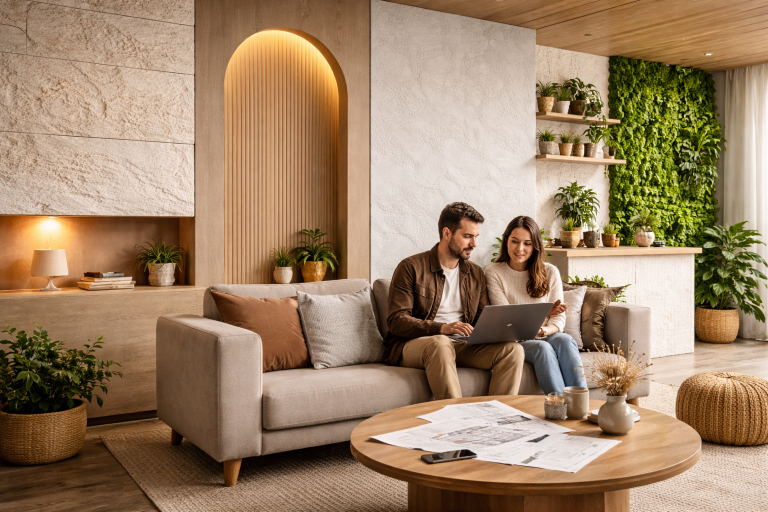
When beauty is no longer enough
For a long time, the success of an interior design project was measured by its visual impact.
A wall was considered successful if it was "beautiful," trendy, and in line with a desired image or atmosphere.
This approach has shaped generations of projects focused on appearance.
But in 2026, it is showing its limitations.
Because a building cannot be experienced through a photograph.
It is experienced over time, through daily use, through the comfort felt, through the fatigue or well-being of its occupants.
Aesthetics remain important.
But when considered in isolation, they become insufficient.
1. Aesthetics respond to the moment, not to duration.
A purely decorative approach often favors:
- The immediate effect,
- The current trend,
- Short-term visual consistency.
However, what appeals when a place first opens is not always what works after several years of use.
The most fragile projects are often those that:
- Designed to impress,
- Without really taking comfort into account,
- Nor from the aging of materials,
- Nor actual usage.
A decorative wall may make a successful entrance... but fail in the long run.
2. Comfort cannot be decreed, it must be built
The comfort of a space is not limited to its appearance.
It results from a set of parameters that are often invisible:
- Acoustics,
- Humidity stability,
- Thermal sensation,
- Indoor air quality.
A wall can be visually appealing while generating:
- Resonance,
- A feeling of coldness or hardness,
- A general feeling of tiredness,
- A discomfort that is difficult to put into words.
When the decorative approach dominates, these dimensions are often dealt with retrospectively, by correction, rather than being integrated from the design stage.
3. Increasingly demanding uses
The buildings now house:
- More people,
- Longer,
- With increased expectations in terms of well-being and health.
Offices, schools, healthcare facilities, public places:
usage has intensified.
In this context, a decorative wall designed without function quickly becomes a constraint:
- Complex maintenance,
- Rapid degradation,
- Discomfort during use,
- Repeated interventions.
A decorative approach alone does not stand up to intensive use.
4. The error of inverted hierarchy
In many projects, the decision-making hierarchy remains inverted:
- We choose aesthetics,
- Then we try to adapt the technique.
This logic often leads to costly or ineffective compromises.
Conversely, a mature approach consists of:
- Analyze usage patterns,
- Define the expected functions,
- Choose materials accordingly,
- Let aesthetics emerge from this consistency.
Aesthetics does not disappear.
It becomes the consequence of the right choice, not its starting point.
5. The wall as a functional component of interior architecture
Rethinking walls beyond their decorative function means recognizing their active role:
- Climate control,
- Contribution to comfort,
- Stability over time,
- Adaptability to different uses.
This approach transforms the wall into an architectural component in its own right, just like lighting, acoustics, or ventilation.
6. When aesthetics align with function
The most successful projects are not those that pit aesthetics against performance.
They are those that align them.
A wall designed to function properly:
- Ages better,
- Less prone to deterioration,
- Stay visually consistent,
- Generates fewer interventions.
The aesthetics gain in simplicity, clarity, and durability.
It ceases to be fragile.
7. A vision championed by Absolin
Absolin's approach is part of this move beyond the decorative approach.
Absolin wall coverings are designed to:
- Perform a real function in the building,
- Contribute to comfort and stability,
- While offering a simple and durable aesthetic.
The goal is not to choose between beauty and functionality, but to refuse to separate them.
Decor without function is a thing of the past
In 2026, continuing to think of walls solely as decorative elements means ignoring the realities of contemporary building.
Usage has evolved.
Expectations have changed.
Requirements have increased.
Aesthetics remain essential.
But on their own, they are no longer enough.