
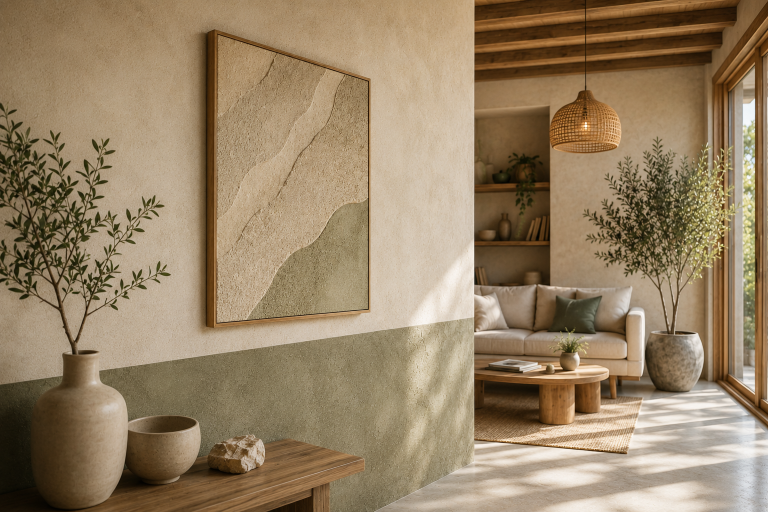
Renovating a building is no longer just about bringing a space up to date. In 2026, renovation projects must meet broader expectations: improving indoor comfort, reducing pollutant emissions, promoting sustainable materials, and offering aesthetic finishes suited to current uses.
In this context, bio-based wall coverings are becoming increasingly important. They meet two key requirements: providing a high-quality decorative finish while supporting a more sustainable approach.
Higher Expectations for Renovations
Architects, general contractors, interior designers, and construction companies are now faced with more specific demands. Project owners are looking for materials that are both aesthetically pleasing and high-performing, while also addressing environmental concerns.
In homes, offices, hotels, public facilities, and educational buildings, the choice of wall finishes is crucial. A wall is no longer just a surface to be covered—it contributes to the comfort, atmosphere, and quality of the interior space.
This is one of the reasons why bio-based solutions are attracting growing interest in renovation projects.
Better indoor air quality
Indoor air quality has become a key issue in the building industry. Occupants spend a large portion of their time in enclosed spaces, where building materials can have a direct impact on their daily comfort.
Certain bio-based wall coverings help limit emissions of volatile organic compounds. This is particularly important in renovation projects, where the goal is often to improve existing spaces without compromising their indoor air quality.
Absolin is in line with this approach, featuring a coating rated A+ for indoor air quality. Its formulation has also been designed to help absorb certain pollutants found in indoor air, particularly formaldehyde.
This aspect is a strong selling point for projects where user comfort is a priority: residential buildings, offices, schools, hotels, or public spaces.
A blend of minerals and plant extracts
The appeal of a bio-based wall covering also lies in the nature of its components.
Absolin combines mineral and plant-based raw materials, including flax, lime, and marble powder. This composition results in a coating that is decorative, functional, and aligned with current market expectations.
Flax adds a natural, plant-based element. Lime and marble powder contribute to the mineral appearance, texture, and final finish. This combination results in a wall finish that goes beyond mere aesthetics to also meet performance and durability requirements.
An attractive finish suited to contemporary projects
Bio-based materials have sometimes been associated with an image that is too rustic or too traditional. This perception no longer reflects current expectations.
Today, bio-based wall coverings can be incorporated into contemporary, minimalist, high-end, or historic projects. They offer textured, mineral-inspired, and decorative finishes that are of particular interest to architects and interior designers.
In a renovation project, this aesthetic aspect is essential. The finish must be suited to the space’s character, the substrate’s limitations, and the desired atmosphere.
Absolin allows you to explore this decorative aspect while maintaining a technical approach. It is therefore suitable for residential projects as well as commercial spaces and public buildings.
Technical Features Useful for Renovation Projects
Wall coverings intended for renovation must be chosen carefully. They must meet specific requirements: the condition of the substrate, the building’s intended use, expected durability, safety, comfort, and longevity.
Absolin offers several technical features that make it a suitable solution for professionals:
- an A+ rating for indoor air quality;
- helps reduce formaldehyde levels;
- a fire rating of B-s1,d0;
- abrasion resistance;
- a water-washable finish;
- properties that contribute to acoustic comfort;
- a thermal conductivity of approximately 0.19 W/(m·K).
These components make it possible to meet a variety of requirements, particularly in renovation projects for offices, public-access facilities, and commercial buildings.
A solution made in France
The origin of materials and their manufacturing processes have also become key selection criteria for many projects.
Absolin is manufactured in France, in Rochefort, Charente-Maritime. This local manufacturing is an asset for specifiers and project owners who wish to incorporate French solutions into their projects.
In a market where materials must be high-performing, traceable, and consistent with environmental commitments, this local aspect enhances the product's credibility.
The Importance of Implementation
The performance of a wall covering also depends on how it is applied. Even a high-quality product can lose its effectiveness if the surface is not properly prepared or if the application instructions are not followed.
That is why training applicators is essential. It helps ensure workplace safety, produces a consistent finish, and guarantees that the product is applied in accordance with the manufacturer’s specifications.
Throughthe Absolin Academy, professionals can learn how to apply the coating, understand its specific characteristics, and master the proper techniques. This is particularly important for companies seeking to position themselves for technical, decorative, or environmentally demanding projects.
A concrete example: FERROCAMPUS
Bio-based coatings are well-suited for projects with high environmental and technical requirements.
The FERROCAMPUS project in Saintes, in Charente-Maritime, illustrates this trend. This low-carbon construction project incorporates building solutions designed to address the new challenges of sustainable construction.
In this type of project, the choice of materials is not limited to their final appearance. It must be guided by a comprehensive approach that takes into account performance, comfort, environmental impact, air quality, and alignment with the building’s objectives.
The use of a coating such as Absolin demonstrates that wall finishes can also contribute to this approach.
Why should you decide on your wall covering early?
In a renovation project, wall coverings are often installed toward the end of the project. However, the choice of wall covering should be decided well in advance.
The substrate, application conditions, the building’s intended use, the desired finish, and regulatory requirements must be assessed in advance. This planning helps prevent errors, allows for better coordination of contractors’ work, and ensures a long-lasting result.
For architects, project managers, and construction companies, incorporating a bio-based finish as early as the design phase makes it possible to offer a solution that is more cohesive and better suited to the project.
In 2026, bio-based wall coverings are gaining popularity in renovation projects because they meet several needs at once: aesthetics, comfort, indoor air quality, technical performance, and environmental sustainability.
With its composition of flax, lime, and marble powder, its French manufacturing in Rochefort-sur-Mer, and its performance characteristics tailored to the demands of the construction industry, Absolin is fully in line with this trend.
For architects, project managers, contractors, and installers, bio-based wall coverings are no longer just an alternative. They are becoming a viable solution for renovating in a different way—with greater consistency, comfort, and sustainability.