
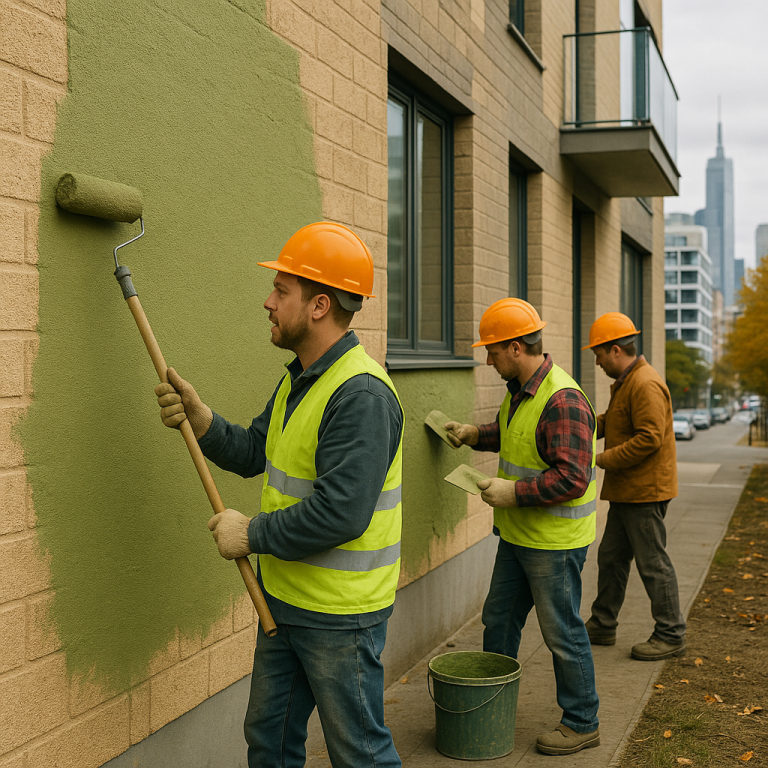
With the arrival of autumn, building professionals are entering a crucial phase: anticipating the thermal comfort needs of buildings while preparing for the winter season. But behind these challenges lies another priority: reducing the carbon footprint of construction sites.
The RE2020 regulation has set ambitious decarbonization targets, and both social and economic pressure are pushing construction industry players to adopt more virtuous solutions. This is where eco-friendly wall coverings, such as biosourced coatings, provide a concrete, sustainable response.
1. Why is autumn a key time to rethink your worksites?
1.1 Buildings under climatic constraints
As winter approaches :
- heating needs increase,
- humidity becomes a recurring problem,
- poorly designed buildings suffer significant energy losses.
1.2 A tougher regulatory environment
Public tenders published in the autumn often call for low-carbon solutions, a sine qua non for selection.
1.3 The opportunity to anticipate the energy transition
Investing in eco-friendly coatings allows you to :
- immediately reduce carbon footprint;
- prepare buildings for the harsher winters caused by climate change.
2. What is ecological wallcovering?
2.1 Definition
An eco-friendly wallcovering is a material designed with a low carbon footprint, derived from natural resources, recyclable and sustainable.
2.2 Composition of biobased coatings
- Linen: local plant fiber, moisture regulation.
- Lime: resistance, antibacterial properties.
- Marble powder: high-end aesthetics, mechanical flexibility.
2.3 Local manufacturing and short supply chains
Produced in France, these coatings are local and traceable, reducing transport and therefore emissions.
3. Reduce your carbon footprint with eco-friendly coatings
3.1 Controlled life cycle
Biobased coatings have a carbon footprint 2 to 3 times smaller than conventional coatings.
3.2 Energy efficiency
By improving thermal comfort, they reduce heating requirements: an immediate gain in energy and CO₂.
3.3 Less waste, more sustainability
Ecological wall coverings can last for decades, eliminating the need for frequent renovations and limiting construction waste.
4. Benefits tailored to the challenges of autumn
4.1 Humidity control
In autumn, humidity becomes a recurring problem. Biobased coatings naturally absorb and release moisture, preventing mold and discomfort.
4.2 Thermal comfort
They help create a warmer interior in winter and a cooler one in summer, reducing unpleasant seasonal variations.
4.3 Healthier indoor air
When buildings are more closed in autumn and winter, the ability of biobased coatings to capture VOCs significantly improves air quality.
5. Concrete jobsite applications
5.1 School buildings
Autumn calls for tender for schools and nurseries demand healthy materials. Environmentally-friendly surfacing meets this priority.
5.2 Multi-family housing
Developers are adopting biosourced coatings in anticipation of growing demand for low-carbon housing.
5.3 Hospital sector
As winter approaches, hospitals are preparing to receive more patients. Healthier indoor air becomes a major argument.
6. A strategic advantage for professionals
6.1 Responding to calls for tender
Many dossiers published in October and November now include the carbon footprint criterion.
6.2 Enhancing your image
A builder who integrates eco-friendly cladding in autumn can communicate on winter preparation and energy savings.
6.3 A profitable investment
The product's durability reduces maintenance costs and ensures a better long-term return on investment.
Autumn 2025 is the ideal time to rethink your building sites and adopt eco-friendly wall coverings.
By reducing carbon footprints, improving the health of occupants and guaranteeing optimal thermal and hygrometric comfort, biosourced coatings are a strategic choice.
For building professionals, architects and local authorities, it's a solution that meets regulatory, climatic and social requirements.